

The official visit of President of the Republic of Uzbekistan Shavkat Mirziyoyev to Georgia is taking place at a time of stronger bilateral cooperation. In recent years, relations between Uzbekistan and Georgia have gained a more stable economic basis. Along with political dialogue, trade, investment, industrial cooperation, transport and logistics are becoming more important.
An important step in the development of economic cooperation between Uzbekistan and Georgia was the official visit of Georgian Prime Minister Irakli Kobakhidze to Uzbekistan in March 2025. During the visit, he met with President Shavkat Mirziyoyev, the leaders of both chambers of the Parliament and Prime Minister Abdulla Aripov. The tenth meeting of the Intergovernmental Commission on Economic Cooperation was also held.
Following the talks, the two sides confirmed their interest in developing trade and economic relations, expanding investment and joint projects, and improving transport and logistics. One of the main goals is to increase bilateral trade to $1 billion. More active use of the Free Trade Agreement between Uzbekistan and Georgia is seen as one of the practical ways to reach this goal.
The current stage of Uzbek-Georgian relations is marked by a shift towards a more practical economic agenda. The main question is how consistently the two sides will turn their agreements into specific trade, investment and industrial projects.
Trade Trends
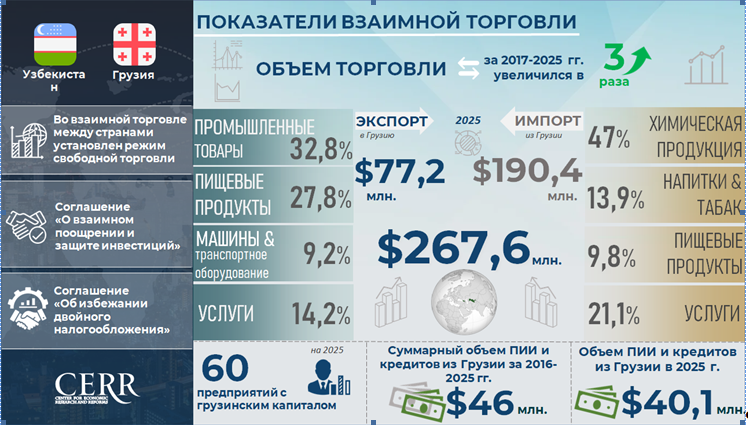
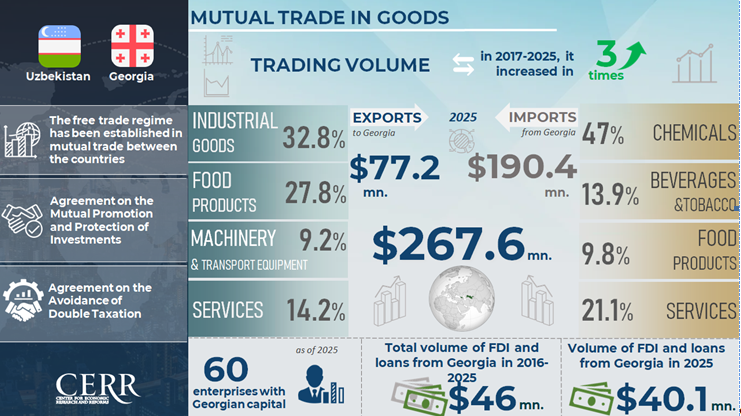
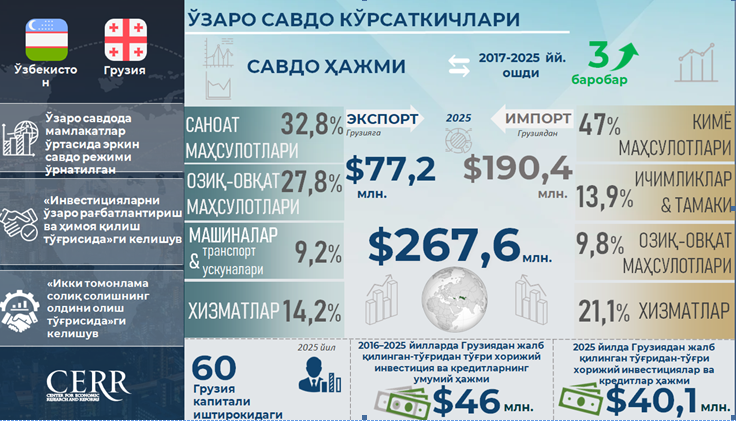
Trade and economic relations between Uzbekistan and Georgia have shown steady growth in recent years. Between 2017 and 2025, bilateral trade tripled from $89 million to $267.6 million.
This positive trend is linked to changes in Uzbekistan’s foreign economic policy and the expansion of the country’s production capacity. Since the start of the economic reforms, the processing of raw materials has increased, while the production of industrial goods and higher-value products has grown. As a result, Uzbekistan has gained more opportunities to sell its goods in foreign markets, including Georgia.
In 2025, Uzbekistan’s exports to Georgia amounted to $77.2 million. Industrial goods accounted for $25.3 million and included copper wire, rolled metal products and electrical equipment. Food products, including pulses, fruit and tobacco, reached $21.5 million. Machinery and transport equipment amounted to $7.1 million. Chemical products, including polymers and fertilizers, totaled $5.7 million. Services, mainly road transport, reached $11 million.
Imports from Georgia amounted to $190.4 million in 2025. Chemical products made up the largest share, mainly medicines worth $89.3 million. Beverages and tobacco accounted for $26.5 million. Food products, including fruit, nuts and mineral water, reached $18.7 million. Manufactured goods and equipment, including medical instruments and devices, amounted to $9 million. Services, including trade and computer services, totaled $40.2 million.
The current trade structure shows that bilateral relations already have a stable economic base. At the same time, trade flows remain uneven. Further growth in trade and economic relations will require an increase in Uzbek exports and a wider range of Uzbek goods on the Georgian market.
Opportunities Under Free Trade
The Free Trade Agreement between Uzbekistan and Georgia was signed in 1995. Its importance is now growing as the structure of Uzbekistan’s economy changes. In the 1990s, trade and transport were mainly linked to raw materials. Today, Uzbekistan produces a much wider range of industrial and processed goods.
Under the free trade system, it is important to expand the range of traded goods, reduce technical and administrative barriers, promote Uzbek products in Georgia, build direct links between companies and involve the regions of both countries in economic cooperation.
The goal of raising bilateral trade to $1 billion requires a major expansion of the trade base. Growth should come from new groups of goods, stable export links and stronger long-term relations between producers, importers and distributors.
This area is especially important for Uzbekistan because the country is steadily increasing the production of higher-value goods. Georgia can serve as a market and as an important link between Central Asia, the South Caucasus, the Black Sea region and Europe.
Investment Cooperation
While trade has grown, investment cooperation has developed at a more moderate pace. Between 2016 and 2025, total Georgian foreign direct investment and loans in Uzbekistan amounted to $46 million. There are 60 companies with Georgian investment registered in Uzbekistan. TBC Bank is one of the most visible examples of Georgian business activity in the country.
Trade in goods has already gained steady momentum. However, joint ventures, industrial cooperation, service projects, digital solutions and the joint promotion of products in third-country markets still need stronger support.
Transport and Its Effect on Trade
Georgia has a strategic location between Europe and Asia. The ports of Batumi and Poti can help make the export routes for Uzbek goods more reliable. However, transport infrastructure can bring economic benefits only when there is enough cargo to move through it.
The Middle Corridor, which connects Central Asia with the South Caucasus, the Black Sea and Europe, is strategically important for Uzbekistan. The route will become more important after the start of construction of the China–Kyrgyzstan–Uzbekistan railway, which is expected to expand transit capacity in both eastern and western directions.
Georgia is one of the important parts of this route in the South Caucasus. Its ports can be reached through Kazakhstan, the Caspian Sea and Azerbaijan, as well as through Turkmenistan, the Caspian Sea and Azerbaijan. These routes give Uzbekistan more options for diversifying its export routes.
A practical step has been the construction of an Uzbek multi-purpose terminal in the Poti Free Industrial Zone. The project covers an area of up to 30 hectares, with total investment estimated at $18.3 million. The first stage includes a cold storage facility with a capacity of 1,000 tons. The second stage includes a 5,000 sq. m covered warehouse for general cargo. Later stages will include facilities for bulk, oversized and container cargo.
The terminal is designed to handle goods from Uzbekistan for further export to Europe. It will also handle European goods sent to Uzbekistan and other Central Asian countries. The importance of the Georgian route is further supported by the ports of Batumi and Poti. Batumi Port can handle up to 18 million tons per year and includes five terminals and 11 berths.
The economic effect of transport cooperation will largely depend on the growth of trade volumes and transport conditions. Important areas include tariffs and route planning, warehouse infrastructure, digital customs procedures, the use of E-Permit, E-TIR and E-Transit systems, and better operations at the ports of Poti and Batumi.
Promising Areas of Cooperation
According to the Center for Economic Research and Reforms, trade between Uzbekistan and Georgia has major unused potential. There are opportunities to expand both the range and volume of Uzbek exports. The main opportunities are in manufacturing, agricultural processing and joint production projects.
In the textile, clothing, leather and footwear sectors, the main opportunities come from Georgia’s high demand for imported products. Georgia imports $539 million worth of textiles and $150 million worth of leather and footwear products. This creates opportunities for Uzbek companies to supply goods directly and develop joint production projects for later sales in third-country markets.
Electrical products may also become an important area of cooperation. Georgia imports cables, transformers, electrical equipment, batteries and household appliances worth about $300 million. As Uzbekistan’s electrical industry develops, this area can support joint projects, including the production of transformers and household appliances, as well as higher exports.
In mining and metallurgy, cooperation may focus on copper mining, processing and copper-based production. Georgia exports about 235,000 tons of copper concentrate worth $479 million and imports 140,000 tons of copper ore worth $237 million. The country also has copper smelting capacity, although it does not fully meet domestic demand. Rich Metals Group could become a promising partner. Its products account for about 10% of Georgia’s exports.
The chemical industry also has potential for cooperation. Georgia exported $272 million worth of chemical products in 2023, including $158 million worth of fertilizers and polymers. One possible area is cooperation with Rustavi Azot, which has a production capacity of 450,000 tons of fertilizers. Projects in this sector could expand production and strengthen positions in the agricultural chemicals market.
The pharmaceutical sector is important because medicines already play a major role in bilateral trade. Georgia imports $38 million worth of immunological products, $11 million worth of antibiotics, $7.3 million worth of vitamins, and $4.3 million worth of cotton wool, gauze and bandages. For Uzbekistan, promising steps include easier registration of medicines in Georgia and the creation of joint production facilities with Aversi and PSP.
The automotive industry may become a longer-term area of cooperation. Georgia imports passenger cars worth $3.3 billion. In 2023, more than 100,000 Mercedes vehicles were sold in the country, accounting for 12.6% of the market. Demand for electric vehicles is also growing. Around 2,000 electric vehicles were sold in 2023, with Nissan accounting for 52% of this segment. This creates opportunities for Uzbekistan to export cars and BYD electric vehicles, while also developing dealer and service networks.
In the building materials sector, promising options include cooperation with Georgian suppliers Nova and GRC LLC. Another possible project is the joint production of energy-saving cement products with HeidelbergCement Georgia.
In the agricultural sector, opportunities include joint ventures, the export of processed food products and scientific cooperation in grape growing, winemaking and the study of mineral waters.
Regional cooperation can make economic relations more practical. Direct links between Samarkand and Batumi, and between Bukhara and Mtskheta, can support tourism, agricultural trade, small and medium-sized businesses, cultural exchanges and joint business events.
Conclusion
Uzbekistan and Georgia are moving towards a stronger model of economic partnership. Over the past nine years, bilateral trade has tripled. This shows that economic cooperation is becoming a stable part of relations between the two countries.
The next stage should focus on practical results from the agreements already reached. A joint working group has been created under the Ministry of Investment, Industry and Trade of the Republic of Uzbekistan and the Ministry of Economy and Sustainable Development of Georgia. Experts from both countries will help turn the agreements into specific trade, investment and infrastructure projects.
Further cooperation will be based on the strengths of both economies and on practical projects in industry, agricultural processing, pharmaceuticals, electrical engineering, financial services, tourism and logistics.
Ziyoda
Rizaeva,
Center for Economic Research and Reforms