
As the SCO approaches its 25th anniversary, the Organization’s
economic component is acquiring an increasingly concrete and practical
character. Today, the Organization brings together 10 states with a combined
population of more than 3.4 billion people, accounting for nearly one-quarter
of global GDP and more than 15% of international trade. The concentration of
markets, resources, and production capabilities creates a significant
foundation for investment, cooperation, and the development of interconnected
infrastructure.
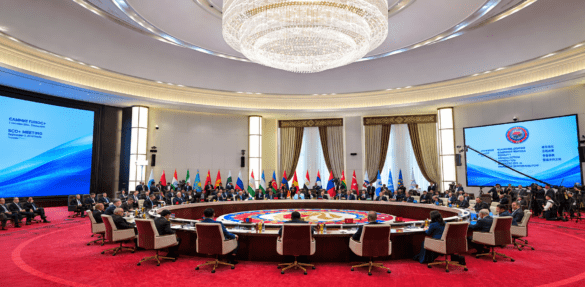
On August 31 – September 1, 2026,
the anniversary SCO Summit will be held in Bishkek, marking the conclusion of
Kyrgyzstan’s SCO chairmanship. The Summit comes in the first year of
implementation of the Strategy for the Development of the Organization until
2035, adopted in Tianjin. From the perspective of the investment, trade, and industrial
agenda, this period is primarily associated with improving conditions for
businesses: reducing barriers, simplifying procedures, expanding production
linkages, developing transport and digital infrastructure, and improving
financing instruments.
For Uzbekistan, this approach
continues the consistently pursued policy of strengthening the economic
dimension of the SCO. The Samarkand Summit of 2022 was an important milestone,
consolidating initiatives in the areas of sustainable supply chains, food and
energy security, and expanding the scope for economic cooperation.
The importance of this resource
for the national economy is already reflected in the dynamics of key
indicators. In 2025, Uzbekistan’s trade turnover with the SCO countries reached
USD 40.6 billion, increasing by 21.7%. In January–June 2026, it amounted to USD
21.9 billion. The volume of investments attracted from the Organization’s
countries reached USD 24.8 billion in 2025 and USD 17.8 billion in the first
half of 2026. The joint investment portfolio includes 1,438 projects with a
total value of USD 102.8 billion.
The volumes achieved make it possible to place greater emphasis on the quality of economic ties — increasing the share of finished products, establishing joint production facilities, localizing technological operations, and developing value-added chains with access to the markets of new countries.
To develop such ties, businesses
need to identify potential areas for industrial cooperation. One of the
instruments is the Industrial Investment Projects Data Bank, the regulations
for which were agreed upon in June 2026. Its value lies in the ability to match
investment initiatives with the capabilities of participating states, their
needs for raw materials and components, available infrastructure, and potential
markets.
This system could be further
developed through the SCO Industrial Cooperation Map, which would make it
possible to link individual initiatives into production chains and identify
areas where the capabilities of different countries complement each other.
At the initial stage, promising
areas include the textile and agro-industrial sectors, which have the relevant
raw material base, production capabilities, and sales channels. In the future,
this approach could be extended to mechanical engineering, electrical
engineering, pharmaceuticals, the chemical industry, and the production of
construction materials.
For each initiative, this model
envisages identifying partners, sources of financing, implementation timelines,
localization parameters, and target markets. This makes it possible to
structure the project economics and define the role of each participant in
advance.
This directly raises the issue of
financial support. In 2025, interested member states took a political decision
to establish the SCO Development Bank, while at the end of June 2026, another
round of consultations was held on its establishment and functioning.
The prospective role of such an
institution is primarily associated with projects whose impact extends across
several countries: transport and energy infrastructure, industrial chains,
digital networks, and logistics centers. Cooperation with existing development
institutions, transparent selection criteria, and financial sustainability
could expand the available range of project financing instruments.
The effectiveness of industrial
cooperation, in turn, directly depends on how quickly and predictably raw
materials, components, and finished products can move. Therefore, the financial
and industrial components are closely linked to transport development.
For Uzbekistan, this factor is
particularly important. The lack of direct access to seaports makes logistics
one of the key conditions for the competitiveness of national products. The
priority is to develop a network of sustainable routes that allows freight
flows to be distributed flexibly while maintaining access to various supply
destinations.
The SCO space encompasses
East–West and North–South routes, road and railway lines, as well as
opportunities for multimodal transportation. For businesses, the efficiency of
such a network depends on infrastructure capacity, the consistency of
procedures, and the speed of the entire chain — from the sender to the final
market.
Therefore, the development of
transport routes is directly linked to the digitalization of processes. The
electronic exchange of customs and permitting documents, advance notification
of control authorities, interoperability of national information systems, and
end-to-end tracking of cargo reduce administrative delays and increase the
predictability of transportation.
The use of accumulated data also
opens up additional opportunities for artificial intelligence — forecasting
freight flows, optimizing routes, managing warehouse infrastructure, and
assessing risks. This requires coordinated approaches to information security
and the protection of national digital systems.
Ultimately, all these instruments serve the development of trade.
Industrial cooperation expands the product base, financing ensures the launch
of new production capacities, logistics connects businesses with markets, and
digital solutions reduce time and administrative costs.
Additional benefits can be achieved through transparent requirements, mutual recognition of electronic documents, and harmonized procedures. This facilitates access for small and medium-sized enterprises to the markets of SCO countries and creates a more predictable environment for investors. At this level, the advantages of multilateral cooperation are directly reflected in the operations of businesses.
The international visibility of
the region also contributes to its economic promotion. Additional attention to
Central Asia during the Summit will be generated by the 6th World Nomad Games.
This large-scale event creates a favorable information environment for
presenting the region’s investment and export potential, national brands, and
business initiatives. For Uzbekistan, this represents an additional opportunity
to demonstrate the country’s economic potential to an international audience.
For Uzbekistan, the value of the
SCO lies in the opportunity to complement well-developed bilateral ties with
instruments that are particularly effective in a multilateral format. These
include projects combining the production capabilities of several countries,
shared infrastructure, new transport routes, and financial mechanisms.
In this context, the Bishkek
Summit will become an important stage in the further development of the
Organization’s economic agenda. Its practical implementation can expand
businesses’ access to markets, investment resources, and logistics
opportunities, while simultaneously creating new conditions for industrial
cooperation.


