

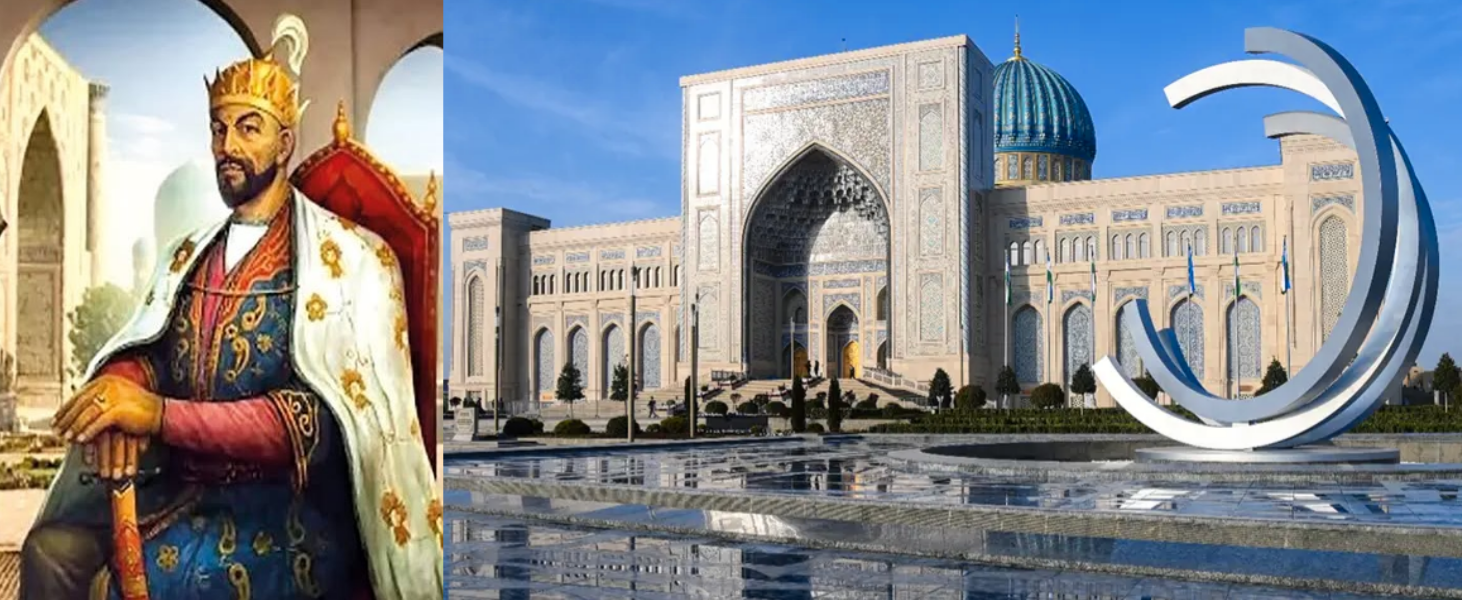
The history of mankind demonstrates that great civilizations rest upon a synthesis of intellectual achievements, spiritual values and cultural heritage. Since ancient times, Central Asia has served as a pivotal hub of science, art and philosophy, shaping the foundational elements of a civilization that has influenced the entire world. Today, this profound potential is embodied in a monumental project – Center of Islamic Civilization in Tashkent. This institution does not merely preserve historical artifacts; it serves as a living platform for science, education and spiritual enlightenment.
The project symbolizes a new stage in Uzbekistan’s development – the Third Renaissance – where the past, present and future are unified through intellectual and cultural heritage. The Center of Islamic Civilization demonstrates how spiritual and educational values can serve as the foundation for national revival and international cooperation, attracting researchers, tourists and the global public.
Amir Temur occupies a distinguished place in world history as an outstanding statesman, military commander, and the creator of one of the largest empires of his time. The late 14th and early 15th centuries were a period of profound political transformations; against this backdrop, Temur succeeded in uniting vast territories stretching from India to the Middle East, establishing a powerful state with a resilient system of governance.
Diplomacy played a pivotal role in his policy. Amir Temur established contacts with European nations, including France, England and Castile; his victory over the Ottoman Sultan Bayezid I at the Battle of Ankara (1402) shifted the balance of power between the East and the West. The Spanish Ambassador Ruy González de Clavijo, who visited Samarkand in 1404, noted the state’s high level of organization, its advanced infrastructure and profound respect shown to foreign envoys.
Samarkand became the capital of the empire, evolving into a cultural and economic hub where the trade routes of China, India, Europe and the Middle East intersected. The city was distinguished by its multi-ethnic population, a sophisticated handicraft system, magnificent architecture, well-tended gardens, advanced irrigation systems and bustling commercial streets.
Amir Temur also established a unique legal foundation for his empire. According to the “Institutes of Temur” (Tuzuk-i-Temuri), the state rested upon four pillars: counsel, discussion, a deliberate plan and decisiveness. Nine-tenths of state affairs were resolved through consultation and prudent measures, and only one-tenth by the sword. This principle reflects the priority of diplomacy and legal resolutions over military force, emphasizing the balance of justice and resolve in governance.
Temur’s social policy was aimed at ensuring order, justice, and economic growth. He supported handicrafts, trade and agriculture, while maintaining strict oversight over officials and punishing abuses of power. Simultaneously, he cared for the welfare of the populace by resettling skilled artisans and creating the necessary conditions for the sustainable development of the state.
Following the passing of Amir Temur, his successors – the Timurids – continued the development of the state, placing particular emphasis on science, culture and education. This period is referred to as the Second Renaissance of Central Asia, characterized by an intellectual and artistic flourishing comparable to the European Renaissance. The most prominent figure of this era was Mirzo Ulugbek, who established one of the preeminent observatories of his time and made significant contributions to astronomy, mathematics, architecture and the arts. His scholarly works influenced not only Islamic but world civilization, laying the groundwork for future scientific discoveries.
Today, the Timurid legacy is preserved within the Center of Islamic Civilization in Tashkent, which houses unique exhibits demonstrating the cultural and spiritual richness of that era. Among them is a fragment of the Quran transcribed by the calligrapher Umar Aqta for Amir Temur, widely known as the “Baysunghur Quran”. This manuscript represents a triumph of calligraphy over ornamentation: the harmonious, powerful forms of the letters and the precise flow of ink create a magnificent visual impact. The Center preserves a single line of this Quran, allowing visitors to experience the grandeur of Timurid art and understand how the culture of letters shaped the spiritual identity of the state.
A place of particular distinction is held by the Timurid/Mughal talismanic shirt – a protective garment crafted in court workshops to provide the wearer with divine safeguarding and blessings. The dense cotton is entirely covered with Quranic inscriptions, including the Shahada and the 99 Names of Allah, while the back features a verse from Surah Yusuf (12:64): “Indeed, Allah is the best guardian, and He is the most merciful of the merciful”. This shirt symbolizes Divine protection and the wearer’s spiritual connection with the Almighty, reflecting the religious depth and artistic mastery of the Timurid era.
Finally, the key to the sacred Kaaba (dated approximately 1425-1426), crafted from brass with silver inlay and inscriptions, preserves the historical memory of the era and its spiritual significance. Together with other exhibits, it enables contemporary visitors to experience the intellectual and cultural ascent of the Second Renaissance and to realize how the spiritual and educational achievements of the past established the foundation for the development of civilization.
Center of Islamic Civilization in Tashkent is not merely a museum but a living educational platform. The architectural concept of the complex harmoniously integrates Timurid traditions with modern technologies, symbolizing the unity of the past and the present. Its 65-meter dome and four golden gates represent the convergence of all regions of Uzbekistan, evoking a sense of monumentality and historical continuity.
Center’s exposition is structured around the principle of “Civilization – Personalities – Discoveries” and spans key historical epochs: the pre-Islamic period, the First and Second Renaissances, Timurid era and contemporary New Uzbekistan. Visitors can not only observe unique artifacts but also interact with them through VR and AR technologies, holograms and artificial intelligence, making history vibrant and tangible.
Center integrates a diverse range of educational and cultural functions: interactive laboratories, including the “1001 Inventions” for children, a library with a collection of over 200,000 volumes, calligraphy schools, and digital archives. It also serves as a hub for offices of international organizations, including UNESCO, ICESCO, IRCICA and OCIS. This creates a space where traditions and innovations coexist and complement each other, stimulating the advancement of science and culture.
The Timurids and the Baburids – including the fragment of the Quran transcribed by Umar Aqta, the talismanic shirt and the key to the Kaaba – are seamlessly integrated into the exposition, allowing visitors to trace how this historical heritage shaped the intellectual and spiritual potential of the region. Through this approach, Center becomes not merely a repository of knowledge, but a living bridge between the Second and the Third Renaissance, ensuring the continuity of traditions and inspiring new generations toward scientific, cultural and spiritual achievements.
The legacy of Amir Temur and his successors plays a pivotal role in the modern world, particularly in shaping the cultural identity of Uzbekistan and fostering international cultural dialogue.
Firstly, it serves as the cornerstone of national identity. The history of the Timurids demonstrates the high level of statehood, science and culture of the region, while their legal and social traditions, reflected in the “Institutes of Temur”, provide an exemplary model of the balance between justice and resolve in governance.
Secondly, the diplomatic experience of Amir Temur remains highly relevant today. His ability to synchronize military strength with flexible and respectful diplomacy serves as an enduring model for contemporary foreign policy and international cultural engagement.
Thirdly, the cultural heritage of the Timurid dynasty fosters international exchange and tourism development. Architectural monuments in Samarkand, Shakhrisabz and other cities attract scholars and visitors from around the world. Exhibits at the Center of Islamic Civilization – including a Quran fragment transcribed by Umar Akta, talismanic Baburid shirt and the key to the Kaaba – allow contemporary visitors to experience the spiritual and intellectual power of the Second Renaissance firsthand.
In this manner, Center of Islamic Civilization becomes the cornerstone of the Third Renaissance, bridging the past and the present while inspiring a new generation toward scientific and cultural achievements.
Center of Islamic Civilization in Tashkent is not merely a museum, but a living bridge between the past and the future. It integrates the spiritual, cultural, and educational accomplishments of Central Asia, creating a space for scientific research, learning and international cooperation.
The legacy of Amir Temur and the Timurids, reflected in the exhibits and the architectural concept of the Center, demonstrates how spiritual and intellectual values can serve as the foundation for national revival. Quranic fragments, talismanic shirts, ceremonial keys and architectural symbols embody the ideas of Divine protection, science and enlightenment, creating a unique cultural space.
The project serves as the cornerstone of the Third Renaissance of New Uzbekistan, inspiring the modern generation toward achievements in science, education and spiritual sphere. Center of Islamic Civilization is evolving into an intellectual and cultural locomotive for the region, fostering the unification of humanity on the path to peace, harmony, and progress, following the great divine command of “Iqra” – “Read in the name of your Lord”.
Dunyo IA


